Introduction to Quantum Computing
Overview
- From bits to qubits: Dirac notation, density matrices, measurements, Bloch sphere
- Quantum circuits: basic single-qubit & two-qubit gates, multipartite quantum states
- Entanglement: Bell states, Teleportation, Q-sphere
From bits to qubits
Classical states for computation are either 0 or 1
In quantum mechanics, a state can be in superposition, ie, simultaneously in 0 and 1.
- Superpositions allow to perform calculations on many states at the same time
- quantum algorithms with exponential speed-up
- But: once we measure the superposition state, it collapses to one of its states
- we can only get one answer and not all the answers to all states in the superposition
- It is not easy to design quantum algorithms, but we can use interference effects
- wrong answers cancel each other out, while the right answer remains
Dirac notation & density matrices
- Used to describe quantum states: let \(a, b \in \mathbb{C}^2\) (2 dimensional vector with complex entries)
- ket: \(| a \rangle = \begin{pmatrix} a_0 \\ a_1 \end{pmatrix}\)
- bra: \(\langle b | = | b \rangle^{\dagger} = (b_0^*, b_1^*)\)
- bra-ket: \(\langle b | a \rangle = a_0 b_0^* + a_1 b_1^* = \langle a | b \rangle^*\)
- ket-bra: \(| a \rangle \langle b| = \begin{pmatrix} a_0 b_0^* & a_0 b_1^* \\ a_1 b_0^* & a_1 b_1^* \end{pmatrix}\)
We define the pure states \(| 0 \rangle = \begin{pmatrix} 1 \\ 0 \end{pmatrix}\) and \(| 1 \rangle = \begin{pmatrix} 0 \\ 1 \end{pmatrix}\) which are orthogonal \(\langle 0 | 1 \rangle = 1 . 0 + 0 . 1 = 0\)
- \(|0\rangle \langle 0| = \begin{pmatrix} 1 & 0 \\ 0 & 0 \end{pmatrix}\)
- \(|1\rangle \langle 1| = \begin{pmatrix} 0 & 0 \\ 0 & 1 \end{pmatrix}\)
-\(\rho=\begin{pmatrix} \rho_{00} & \rho_{01} \\ \rho_{10} & \rho_{11} \end{pmatrix}=\rho_{00} |0\rangle \langle 0| + \rho_{01} |0\rangle \langle 1| + \rho_{10} |1\rangle \langle 0| + \rho_{00} |1\rangle \langle 1|\)
All quantum states can be described by density matrices, ie normalized positive Hermitian operators, \(\rho\) with \(tr(\rho)=1\), \(\rho\geq 0\), \(\rho=\rho^{\dagger}\)
for \(\rho=\begin{pmatrix} \rho_{00} & \rho_{01} \\ \rho_{10} & \rho_{11} \end{pmatrix}\), \(tr(\rho)=\rho_{00}+\rho_{11}=1\), \(\langle \psi | \rho | \psi \rangle \geq 0 \quad \forall \psi\),
- All quantum states are normalized, ie, \(\langle \psi | \psi \rangle = 1\)
- Spectral decomposition: for every density matrix \(\rho \exists\) and orthonormal basis \(\{\ i \rangle\}_i\) s.t. \(\rho = \sum_i \lambda_i | i \rangle \langle i |\) where \(| i \rangle\) eigenstates, \(\lambda_i\) eigenvalues and \(\sum_i \lambda_i = 1\)
- A density matrix is pure if \(\rho = | \phi \rangle \langle \phi |\), otherwise it is mixed.
- if \(\rho\) is pure, one eigenvalue equals 1, all others are 0. \(tr(\rho^2)=\sum_i \lambda_i^2=1\) if \(\rho\) pure, otherwise \(tr(\rho^2)<1\)
Measurements
We choose orthogonal bases to describe & measure quantum states (projective measurement). During a measure onto the basis\(\{ | 0 \rangle , | 1 \rangle \}\), the state will collapse into either state \(| 0 \rangle\) or \(| 1 \rangle\). We call this a z-measurement (\(| 0 \rangle\) and \(| 1 \rangle\) are the eigenstates of \(\sigma_z\))
There are infinitely many different bases, but the most common ones are: \(\{ | + \rangle, | - \rangle \} = \{ \frac{1}{\sqrt{2}} (| 0 \rangle + | 1 \rangle), \frac{1}{\sqrt{2}} (| 0 \rangle - | 1 \rangle) \}\) (eigenstates of \(\sigma_x\)) \(\{ | +i \rangle, | -i \rangle \} = \{ \frac{1}{\sqrt{2}} (| 0 \rangle + i | 1 \rangle), \frac{1}{\sqrt{2}} (| 0 \rangle - i | 1 \rangle) \}\) (eigenstates of \(\sigma_y\))
- Born Rule: the probability that a state \(| \psi \rangle\) collapses during a projective measurement onto the basis \(\{ |X \rangle, |X^\perp \rangle \}\) to the state \(| X \rangle\) is given by \(P(x) = | \langle x | \psi \rangle|^2\) where \(\sum_i P(x_i) = 1\)
Bloch Sphere
We can write any normalized (pure) state as \(| \psi \rangle = \cos{\frac{\theta}{2}} | 0 \rangle + e^{i \phi}\sin{\frac{\theta}{2}} | 1 \rangle\) where \(\phi \in [0, 2 \pi ]\) describes the relative phase and \(\theta \in [0, \pi]\) determines the probability to measure \(| 0 \rangle\) and \(| 1 \rangle\): \(P(| 0 \rangle) =\cos^2 \frac{\theta}{2}\) and \(P(| 1 \rangle)=\sin^2 \frac{\theta}{2}\)
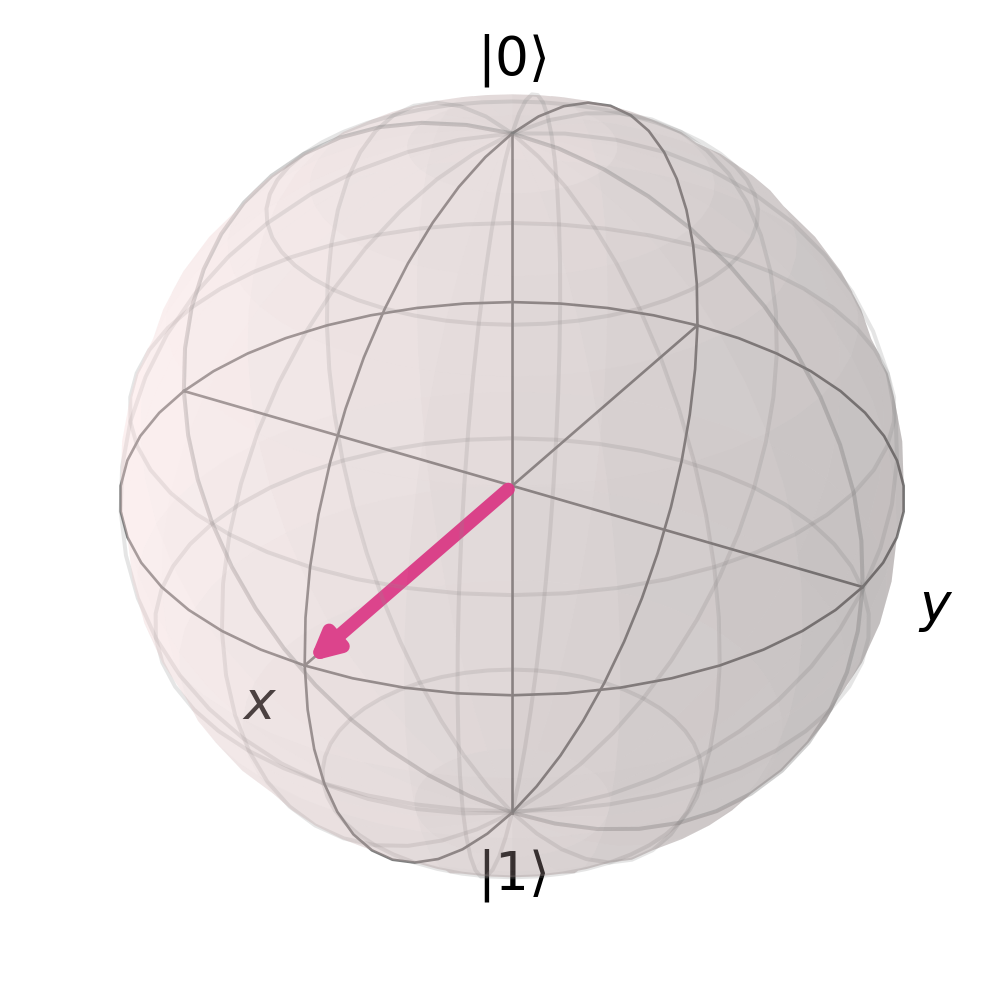
All normalized pure states can be illustrated on the surface of a sphere with radius 1, which we call the Bloch sphere. The coordinates of such a state are given by the Bloch vector \(\vec{r} =\begin{pmatrix} \sin{\theta} \cos{\phi} \\ \sin{\theta} \sin{\phi} \\ \cos{\theta}\end{pmatrix}\)
On the Bloch sphere, angles are twice as big as in Hilbert space. Here, \(\theta\) is the angle on the sphere while \(\frac{\theta}{2}\) is the actual angle in Hilbert space.
Quantum Circuits
The base “circuit model” can be defined as: a sequence of building blocks that carry out elementary computations called gates
add scheme here
Single qubit gates
- Classical example: the NOT gate (add scheme)
- Quantum example: as quantum theory is unitary, quantum gates are represented by unitary matrices: \(\mathcal{U}^{\dagger}\mathcal{U}=1\)
Elementary gates: the Pauli matrices
\(\sigma_x, \sigma_y, \sigma_z\) are the so-called Pauli matrices, \(\sigma_i^2 =\mathcal{1}\)
Together with \(\mathdd{1}\) they form a basis of 2x2 matrices
Any 1-qubit rotation can be written as a linear combination of them
- \(\sigma_x\) the bit flip gate
\(\sigma_x = \begin{pmatrix} 0 & 1 \\ 1 & 0 \end{pmatrix}\)
\(\sigma_x | 0 \rangle = | 1 \rangle\) and \(\sigma_x | 1 \rangle = | 0 \rangle\)
rotation around x-axis by \(\pi\)
- \(\sigma_z\) the phase flip gate
\(\sigma_z = \begin{pmatrix} 1 & 0 \\ 0 & -1 \end{pmatrix}\)
\(\sigma_z | + \rangle = | - \rangle\) and \(\sigma_x | + \rangle = | - \rangle\)
rotation around z-axis by \(\pi\)
- \(\sigma_y\) the bit & phase flip gate
\(\sigma_y = \begin{pmatrix} 0 & -i \\ i & 0 \end{pmatrix} = i \sigma_x . \sigma_z\)
- The Hadamard gate
One of the most important gates for quantum circuits
\(\mathcal{H} = \frac{1}{\sqrt{2}} \begin{pmatrix} 1 & 1 \\ 1 & -1 \end{pmatrix}\)
\(\mathcal{H} | 0 \rangle = | + \rangle\) and \(\mathcal{H} | 1 \rangle = | - \rangle\)
Creates superposition of states!
\(\mathcal{H} | + \rangle = | 0 \rangle\) and \(\mathcal{H} | - \rangle = | 1 \rangle\)
Also used to change between X and Z basis
- The \(\mathcal{S}\) gate
\(\mathcal{S} = \begin{pmatrix} 1 & 0 \\ 0 & i \end{pmatrix}\)
Adds \(90°\) to the phase \(\phi\)
\(\mathcal{S} | + \rangle = | +i \rangle\) and \(\mathcal{H} | - \rangle = | -i \rangle\)
\(\mathcal{S} . \mathcal{H}\) is used to change from Z to Y basis
Multipartite quantum states
We use tensor products to describe multiple states
\(| a \rangle \otimes | b \rangle = \begin{pmatrix} a_1 \\ a_2 \end{pmatrix} \otimes \begin{pmatrix} b_1 \\ b_2 \end{pmatrix} = \begin{pmatrix} a_1 b_1\\ a_1 b_2 \\ a_2 b_1 \\ a_2 b_2 \end{pmatrix}\)
Example: system A is in state \(| 1 \rangle_A\) and system B is in state \(| 0 \rangle_B\)
the total bipartite state is \(| 10 \rangle_{AB} = | 1 \rangle_A \otimes | 0 \rangle_B = \begin{pmatrix} 0 \\ 1 \end{pmatrix} \otimes \begin{pmatrix} 1 \\ 0 \end{pmatrix} = \begin{pmatrix} 0 \\ 0 \\ 1 \\ 0 \end{pmatrix}\)
States of this form are called uncorrelated, but there are also bipartite states that cannot be written as \(| \psi \rangle_A \otimes | \phi \rangle_B\).
These states are correlated and sometimes even entangled (very strong correlation)
e.g. \(| \psi^{(00)}\rangle_{AB}= \frac{1}{\sqrt{2}} (| 00 \rangle_{AB} + | 11 \rangle_{AB}) = \frac{1}{\sqrt{2}} \begin{pmatrix} 1 \\ 0 \\ 0 \\ 1 \end{pmatrix}\) a so-called Bell state, used for teleportation, cryptography, Bell test, …
Two-qubit gates
Classical example: XOR gate (add scheme) irreversible: given the output we cannot recover the input
| XOR | input | output |
| x y | x + y | |
| 0 0 | 0 | |
| 0 1 | 1 | |
| 1 0 | 1 | |
| 1 1 | 0 |
Quantum example: CNOT gate (add circuit)
as quantum theory is unitary, gates are reversible
\(\text{CNOT}=\begin{pmatrix} 1 & 0 & 0 & 0 \\ 0 & 1 & 0 & 0 \\ 0 & 0 & 0 & 1 \\ 0 & 0 & 1 & 0 \end{pmatrix}\)
\(\text{CNOT} | 00 \rangle_{xy} = | 00 \rangle_{xy}\)
\(\text{CNOT} | 10 \rangle_{xy} = | 11 \rangle_{xy}\)
We can show that every classical function \(f\) can be described by a reversible circuit.
Quantum circuits can perform all functions that can be calculated classically.
Entanglement
If a pure state \(| \psi \rangle_{AB}\) on systems A and B cannot be written as \(| \phi \rangle_A \otimes | \Phi \rangle_B\), it is entangled
Bell states
There are four so-called Bell states that are maximally entangled and constitute an orthonormal basis:
\(| \psi^{00}\rangle = \frac{1}{\sqrt{2}} (| 00 \rangle + | 11 \rangle)\)
\(| \psi^{10}\rangle = \frac{1}{\sqrt{2}} (| 00 \rangle - | 11 \rangle)\)
\(| \psi^{01}\rangle = \frac{1}{\sqrt{2}} (| 01 \rangle + | 10 \rangle)\)
In general, we can write \(| \psi^{ij}\rangle = ( \mathcal{1} \otimes \sigma_x^j \sigma_z^i) | \psi^{00} \rangle\)
Creation of Bell states
(add scheme)
| \(\mid ij \rangle_{AB}\) | \(\mathcal{H}_A \otimes \mathdd{1}_B \mid ij \rangle_{AB}\) | \(\mid \psi^{ij} \rangle\) | ||
| \(\mid 00 \rangle\) | \(\mathcal{H_A}\) | \(\frac{1}{\sqrt{2}}(\mid 00 \rangle + \mid 10 \rangle)\) | \(\text{CNOT}_{AB}\) | \(\frac{1}{\sqrt{2}}(\mid 00 \rangle + \mid 11 \rangle) = \mid \psi^{00}\rangle\) |
| \(\mid 01 \rangle\) | \(\frac{1}{\sqrt{2}}(\mid 01 \rangle + \mid 11 \rangle)\) | \(\frac{1}{\sqrt{2}}(\mid 01 \rangle + \mid 10 \rangle) = \mid \psi^{01}\rangle\) | ||
| \(\mid 10 \rangle\) | \(\frac{1}{\sqrt{2}}(\mid 00 \rangle + \mid 10 \rangle)\) | \(\frac{1}{\sqrt{2}}(\mid 00 \rangle - \mid 11 \rangle) = \mid \psi^{10}\rangle\) | ||
| \(\mid 11 \rangle\) | \(\frac{1}{\sqrt{2}}(\mid 01 \rangle - \mid 11 \rangle)\) | \(\frac{1}{\sqrt{2}}(\mid 01 \rangle - \mid 10 \rangle) = \mid \psi^{11}\rangle\) |
Bell measurement
(add scheme)
classical outcomes \(i,j\) correspond to a measure of the state \(| \psi^{ij} \rangle\)
Teleportation
Alice wants to send her (unknown) state \(|\phi \rangle_S = \alpha | 0 \rangle_S + \beta | 1 \rangle_S\) to Bob. She can only send him two classical bit though. They both share the maximally entangled state \(| \psi^{00} \rangle_{AB} = \frac{1}{\sqrt{2}} (| 00 \rangle_{AB} + | 11 \rangle_{AB} )\).
- Initial state of the total system:
\(| \phi \rangle_S \otimes | \psi^{00} \rangle_{AB}\)
- Protocol
(add scheme)
- Alice performs a measurement on S and A in the Bell basis.
- She sends her classical outputs \(i,j\) to Bob.
- Bob applies \(\sigma_z^i \sigma_x^j\) to his qubit and gets \(| \phi \rangle\).
| Alice’s meas. | Bob’s state | Alice sends | Bob applies | Bob’s final state |
| \(\mid \psi^{00}\rangle\) | \(\mid \phi \rangle_B\) | 0 0 | \(1\) | \(\mid \phi \rangle_B\) |
| \(\mid \psi^{01}\rangle\) | \(\sigma_x \mid \phi \rangle_B\) | 0 1 | \(\sigma_x\) | \(\mid \phi \rangle_B\) |
| \(\mid \psi^{10}\rangle\) | \(\sigma_z \mid \phi \rangle_B\) | 1 0 | \(\sigma_z\) | \(\mid \phi \rangle_B\) |
| \(\mid \psi^{11}\rangle\) | \(\sigma_x \sigma_z \mid \phi \rangle_B\) | 1 1 | \(\sigma_z \sigma_x\) | \(\mid \phi \rangle_B\) |
Note that Alice’s state collapsed during the measurement, so she does not have the initial state \(| \phi \rangle\) anymore. This is expected due to the no-cloning theorem, as she cannot copy her state, but just send her state to Bob when destroying her own.